
My Third Lung
No. 224: Mom's Letter/Zuihitsu; Eric & Martin Demaine, Joan Takayama-Ogawa, Henry Eiland, Persistent Bloom, & Ralph Pugay; Constantinople ensemble, & Reyben Kim.

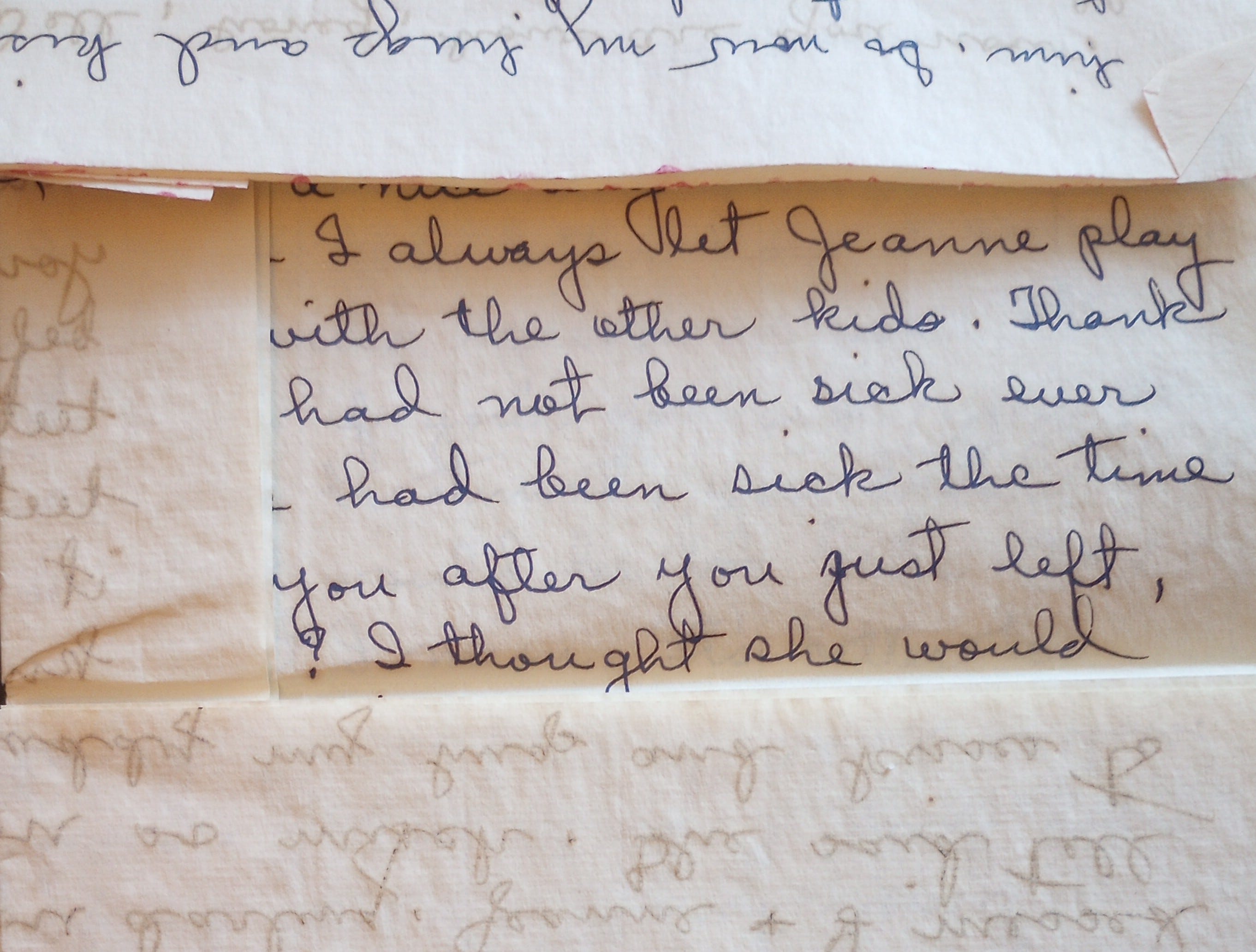
I have many letters written from my father to my mother, but few letters from my mother to him or anyone else. I begin this issue with zuihitsu responding to a letter from my mother to my father, who was then working aboard the USNS Fred C. Ainsworth in 1959:
At Home
July 1, 1959
My dearest darling,
It is a nice day here in Santa Cruz and I always let Jeanne play outside with the other kids. Thank God she had not been sick ever since she had been sick the time I wrote you after you just left, remember? I thought she would always be sick again in short time all over again. That made me worry so much about her, you know. I always let her play her bike especially in the morning when it’s already getting warm. I know fresh air and sunshine is good for her especially this summer.
My Zuihitsu response:
A letter as touchstone to make contact and be in relationship, in the same way that underground threads of mycelium reach towards sustenance.1
But why the title “At Home”? Obviously she was at home. Perhaps it was a common anchor phrase in post-war letters saying “yes, at last, I’m home; we have a home.”
Sick child, sick child. I heard it again and again. I’d like to leave that behind. But I can’t. Asthma and gasping for breath. Weirdly, though, I got used to these episodes. I learned to pay attention to what my body was telling me. Theophylline was prescribed, and later epinephrine in an inhaler. Nowadays, it’s albuterol.
I remember meals and snacks Mom brought to me as I lay in bed. Saltine crackers and peanut butter. Oreos and milk—lots of it (milk was a big deal back then; at school we’d get USDA food guide handouts to take home, with pasteurized milk touted as the ultimate calcium bone-builder ). I still have asthma, though well controlled. My inhaler is like a portable third lung that I carry around in my pocket.
There were very few books in our house. The few we had kept me company during asthma attacks. They were purchased from WWII veterans who arrived as door-to-door salesmen selling dictionaries, encyclopedias, and Readers’ Digest condensed books.
During one long, asthmatic week spent in bed, I read the entirety of Margaret Mitchell’s brick of a novel Gone With the Wind, and the Digest’s condensed version of Rumer Godden’s An Episode of Sparrows.2 The first taught me all I needed to know about America’s repressed sexuality, racism, civil war, and breast-heaving romantic tension. The second, with its lovely ink sketches, introduced me to the world of post-war London’s working classes struggling to rebuild amid the rubble of their blasted neighborhoods. I sympathized with that little girl trying to grow a garden in a tiny patch of dirt among the ruins—only to have it kicked to bits by a territorial gang of neighborhood boys.3
My mother, too, was busy growing a post-war garden in the front and back yards around our house. In the same letter, she wrote:
Now I’m taking it easy while I’m not working yet at Birds Eye [cannery]. But I’m always busy in our yard every day. Our backyard looks so beautiful now honey with the flowers. I could hardly wait to see you darling. Jeanne and I missed [sic] you so much. She said tell Daddy my hugs and kisses to him. So now my hugs and kisses to you too darling,
RABBIT HOLE
Eric & Martin Demaine, father and son curve-crease origami artists. Their video is a breath of fresh air as we enter 2026:
I’m feeling inspired by ceramic artist Joan Takayama-Ogawa (mentioned in credits to the Demaine video above). Thinking of her “vessels” inspired by indigenous Mimbres ceramic designs. Mimbres funeral pottery is sometimes found with holes punched in the centers, as if they represent an doorway through which one escapes into a larger reality. Vessels hold things, and the term also describes a boat that takes you on a journey. I’m reminded of the tiny Philippine boats that decorate some indigenous funeral pottery, and the symbolism of that.
Below, Takayama-Ogawa talks about channeling anger through her craft:
Photographer Henry Eiland has been documenting the 2025 Peace Walk by a group of Theravada Buddhist monks, and their dog Aloka. They are heading 2,300 miles by foot from Fort Worth, TX—through the “Bible Belt”— to Washington, DC. They do not carry any food, and eat only what is offered to them. Some of them have been walking barefoot. Here’s the AP report “Buddhist Monks and their dog captivate Americans while Walking for Peace.”
Mel Mitchell-Jackson from Persistent Bloom on “How to Heal Your Attention”:
Inspired, to some extent, by The Sims life simulation video games, Ralph Pugay’s paintings depict the absurdities of this American life. Take, for example, his mural “Too Many Dogs at the Dog Park” or a painting titled “Gym of the Night” (where vampires go to get pumped))—they make me laugh!
SOUNDINGS
Constantinople ensemble performs music from their album, Traversées, “a musical journey from Asia to the New World through Africa—a dialogue of deep layers of musical conversations and exceptional harmony between Persian Setar master Kiya Tabassian, and Senegalese and Kora master and Griot, Ablaye Cissoko, supported by percussionist Patrick Graham.”
Reyben Kim (of Reyben Kim Woodwinds) shows you how to play the Cordilleran nose flute, or Kalaleng (I want one!):
Big thanks to all of you who read Eulipion Outpost regularly, and to those who have subscribed or donated on my Ko-fi page to support my efforts. Donations contribute to my rent payments!
My thanks and appreciation go to the Mysterious M. for editing support and expertise!
My website: Jeanvengua.com
Eulipion Outpost is a reader-supported publication. To receive new posts and support my work, consider becoming a free or paid subscriber:
See Merlin Sheldrake’s book Entangled Life: How Fungi Make Our Worlds, Change Our Minds & Shape Our Futures.
Both were made into feature films, Gone With the Wind starred Clark Gable & Vivien Leigh, and Episode of Sparrows (as Innocent Sinners) starred Flora Robson and David Kossoff.
One of the boys later returned to help her find a safer area to plant her garden.
I love your sharing of the letters between your mother and father - and your reflections. So loving. Keep on. So important. I just returned from the Philippines traipsing around Ilocos Norte with my son Leo, comparing the pinacbet in each town. Learning much; much more to learn. Connecting with family, cousins and a few scholars and historians. Wishing you a Happy New Year; strength, energy & joy.