
If Nothing Else, Just This
No. 226: If Nothing Else, Just This; the Letter Project; Sister Corita Kent, Irene Lee, Filipino American Art Spaces, Janna Añonuevo Langholz, Nanook, and Avie Sheck & Uma

ART
Somebody (sorry, I forgot who) online—possibly more than one person—wrote that in times like these, if you are an artist of any sort, it’s important to keep going—no matter what you are creating. It’s important to nurture that exploratory sense, that imagination. Doesn’t matter if it’s abstract to the nth degree, conceptual, surreal, overtly political, or whatever. Hold and nurture that light. Recently, one phrase has been helpful:
“If nothing else, just this.”
In my last issue, I mentioned my friend Joan and her “Buson 100 challenge.” She passed away on Monday, January 19. I started my daily drawing practice that afternoon in gratitude to Joan (and to her poet-hero Buson).
There’s no pressure for me to make something great. Good, bad, terrible, beautiful are all fine in this process. The point is to just draw (or paint, or collage) something everyday on a small piece of paper roughly 4.5 x 6 inches. I’ve got a lot of 9 x 12 inch heavy paper that I want to use up by folding and cutting it into quarters. The size may vary slightly.
Below are several of the drawings. They don’t have titles, just numbered and dated:
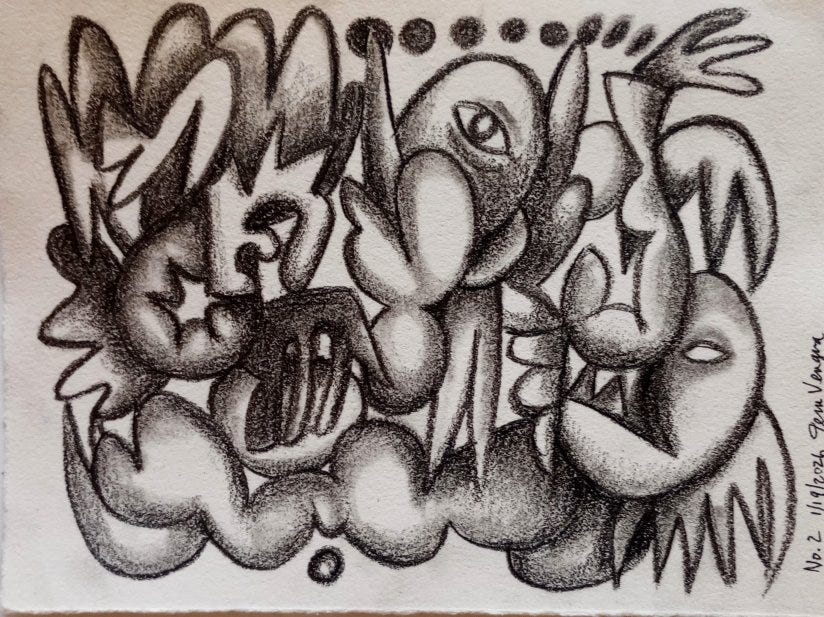
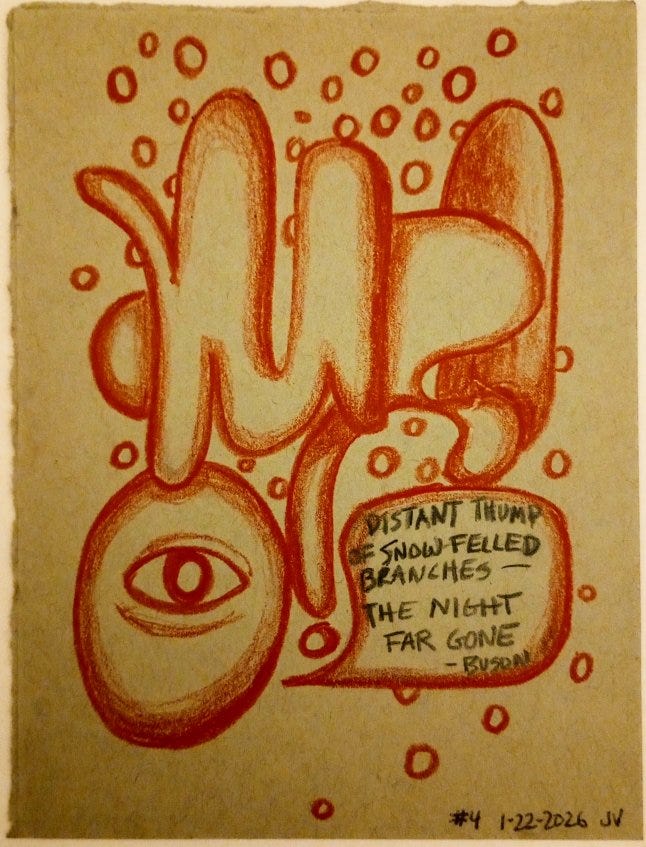
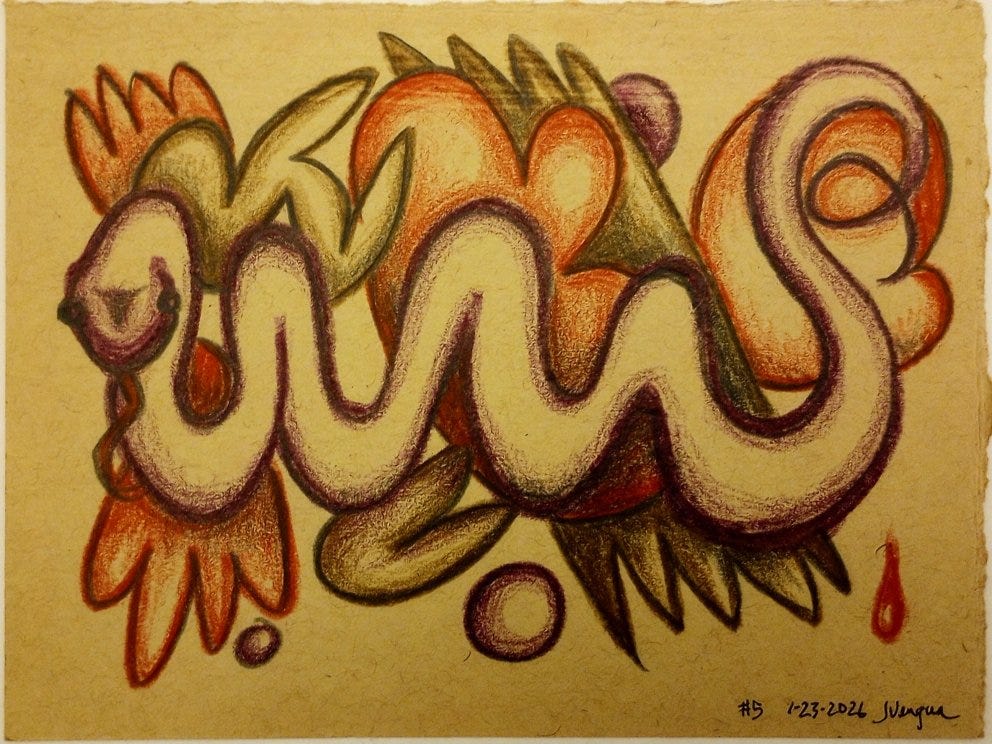
These small drawings are very different from the more abstract pieces I’ve been doing for the last few years. I don’t know why they’re coming up this way. One word suggests itself when I look at these: entanglement. Perhaps I’m more aware, these days, of how tangled I am in other’s lives.
LETTER PROJECT
As I wrote previously, 1959 was a terrible year for my mom and her family in the Philippines. Mom had a long-standing dental ailment (something that developed during the WWII siege of Manila, when many of its population were starving), and had to have all her teeth extracted and replaced with dentures. Both my grandmother and my youngest uncle’s wife, Lou, passed away rather unexpectedly—from cancer. Oscar, my father’s friend and brother of my Aunt’s husband, was murdered over a workplace conflict. My mom and I stayed at a friend’s house for a couple weeks while Mom nursed her grief.
By June, 1960, we were back to life as usual, more or less. From their letters, it seemed as though both my parents were trying to assuage their sadness through consumerism. My dad’s letter of June 7 announced to Mom that he was borrowing money in order to buy an expensive suit:
I guess you know already that I made up my mind to get the suit I told you about. I managed to borrow in order to pay for the suit. It’s going to be the best suit I ever had . . . In San Francisco, it would cost me around a hundred dollars. Anyway, I’m not buying anymore clothes. So, next pay day, you’ll get most of my paycheck. Okay, darling?
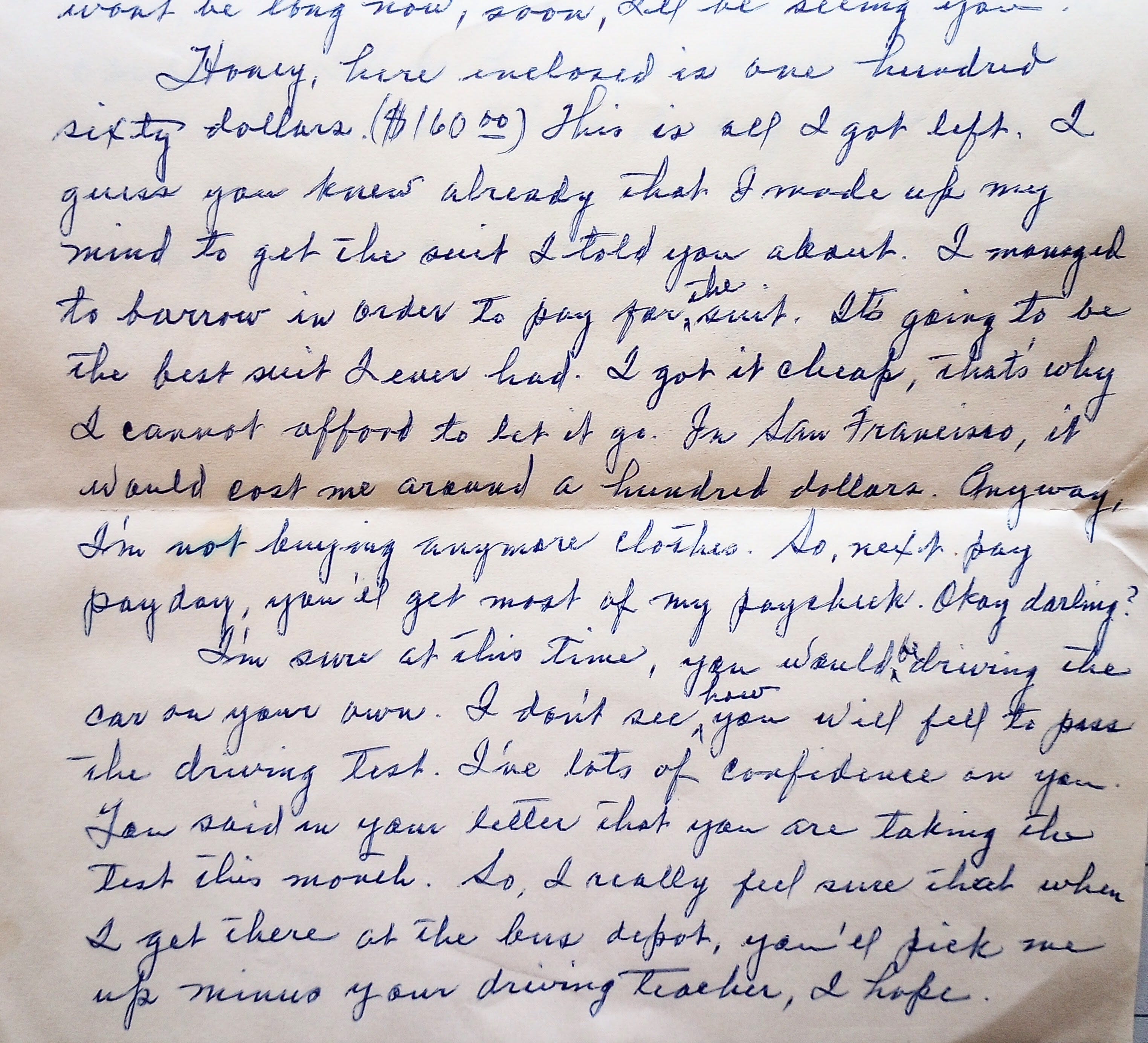
As I read his letter, I thought of the Filipino manongs in the US during the 1930s-40s and their love of fine, tailored suits, even though their low-paying jobs as field laborers or service workers made purchasing such suits a challenge.
Photo of Dad from his tailored manong days:
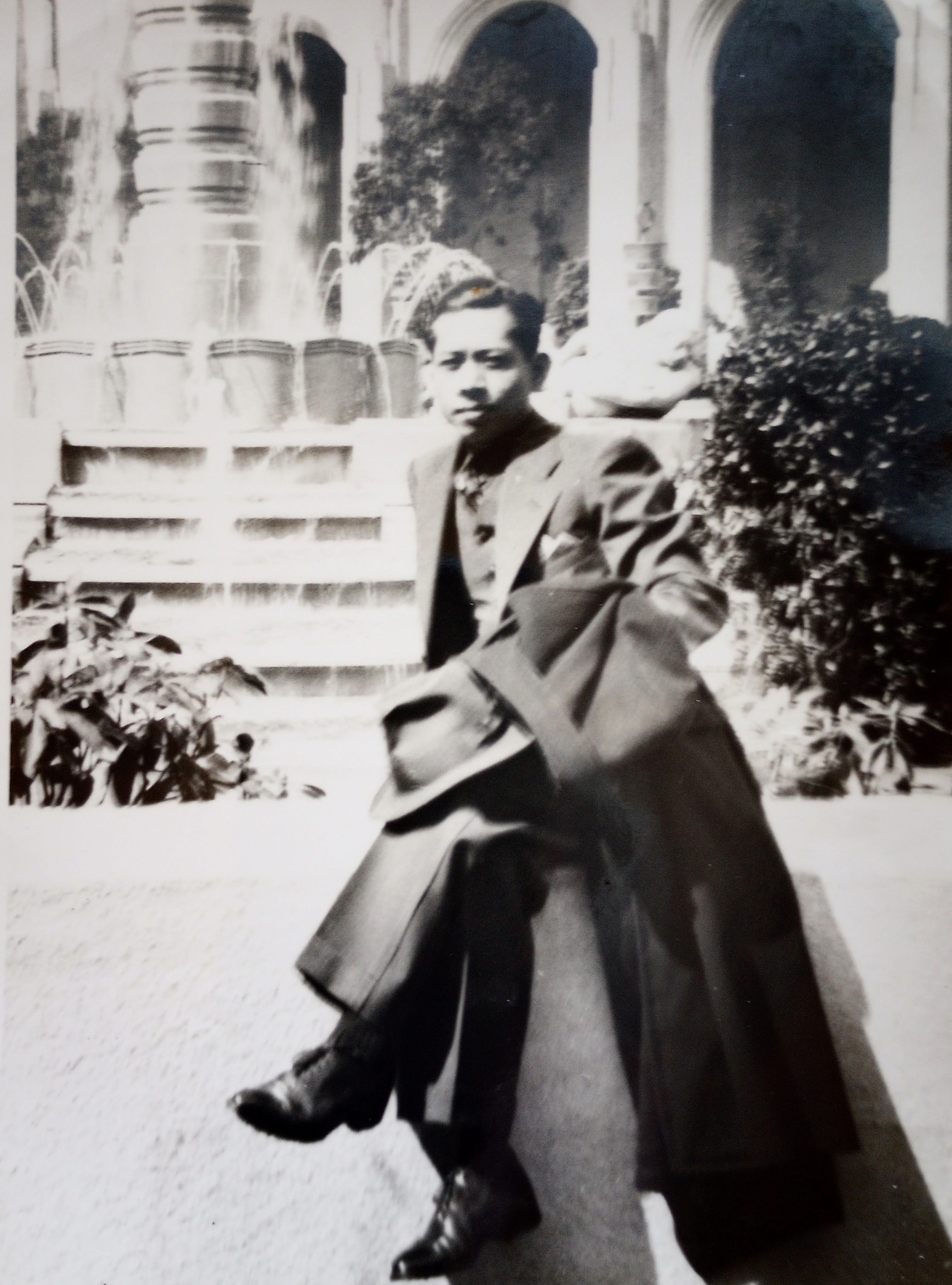
There’s a similar photo from that period of Dad’s half brother, Miguel, wearing a tailored suit. But Mom exceeded Dad by her purchase of a bright red Chevy Corvair.
The 1950s was an era of big cars. I still remember my babysitter Jan’s candy red Chevy Impala convertible, which she christened “Cinnamon.” And our next door neighbor’s huge, round-shouldered Oldsmobile, painted forest green, with seats you could get lost in.
On the other hand, the Chevy Corvair—a compact with its engine in the rear—was considered “revolutionary” at the time; it was a cool car to own. But Mom didn’t know how to drive, so she signed up for lessons at a local driving school, and apparently did well.
A few years later, a young, crusading Ralph Nader questioned the safety of the car in his book Unsafe at Any Speed.1 Nader is currently in his 90s and has a podcast on Substack. His work is still relevant today. Check out this interview of him on the Dick Cavett Show in the 1970s:
I would argue that Mom did not really become enmeshed in US culture until she bought that car. To a large extent automobiles symbolize America’s fantasy of rugged “individualism” and most of all “freedom.” But as we now see in our government’s desperate attempts to colonize Greenland and Venezuela for their oil and mineral resources, that freedom comes at a price.
RABBIT HOLE
I’m reminded by Sarah Bush (Pink Teacup) of Sister Corita Kent and various artists, especially of the 1960s-70s involved in resistance and protest movements.
Irene Lee: “The Woven History of Filipino American Artists” (Hyperallergic).
Filipino American Art Spaces in the [San Francisco] Bay Area. I was a member of Kearny St. Workshop during the early 1990s. (The article was by Balay Kreative, which had to close its operations in 2025, due to budget cuts.)
Artist/activist Janna Añonuevo Langholz with investigative reporters Claire Healy and Nicole Dungca investigate what happened to a group of indigenous Filipinos who died at the 1904 World’s Fair in St. Louis, and in the process discover the Smithsonian’s “racial brain collection.” Because these people were viewed as museum “specimens,” many of their names were not recorded.
SOUNDINGS
Akornatsinniittuassaatit, a song by the band Nanook—with vocals by Frederik Elsner, featuring Ole Kristiansen—takes its title from the name of an Inuit Greenlandic woman Arnarulunnguaq who traveled with her cousin Qaavigarsuaq (Miteq) and the explorer Knud Rasmussen on the grueling 18,000 km dog‑sled journey from Greenland across the Canadian Arctic to the Bering Strait.2 She was the first woman to complete that trans‑Arctic trek.
English lyrics:
“You will always be among us”
Silence has reached us and the nature
long - long - long time ago they always said you where strong
Without noticing it we are surrounded
your beauty and greatness blinds us
Was Iggiannguaq the reason why you
Arnarulunnguaq where so mentally strong?
long - long - long time ago they always said you where persevering
We keep hearing remaining old stories
but we keep forgetting how we live our lives
When the moonlight shines on you
it gave you hope and you used it for strength
you moved on with bravery resulting in death through illness
but you will always be in our minds.
Avie Sheck and his mom Uma cover “Mind over Matter” by Young Giant. They recorded this soon after New York City elected Zohran Mamdani as their new mayor:
Big thanks to all of you who read Eulipion Outpost regularly, and to those who have subscribed or donated on my Ko-fi page to support my efforts. Donations contribute to my rent payments!
My thanks and appreciation go to the Mysterious M. for editing support and expertise!
My website: Jeanvengua.com
Eulipion Outpost is a reader-supported publication. To receive new posts and support my work, consider becoming a free or paid subscriber:
I don’t recall that our Corvair had any significant problems.
I just read The Man in the McIntosh Suit, a graphic novel by Ria Ayuyang. The suits were truly a status symbol for the Manongs.
Thanks, Carol -- Onward!