
The Circle Expands
No. 230: Art; The Circle Expands; Radical Attention, Seung Ah Paik, Char Villena, J. Christian Jensen, Beth Ann Fennelly, Lindsey Frances Jones, Devon Rodriguez, Fog Chaser, & Toro y Moi

ART
Daily Art Cycle
Ah, life is so strange and confusing and scary lately. And busy. But I’m glad to have a daily art practice, something to focus on besides my phone and the news.
I’m normally not a person who leans into routine—in fact, just the opposite. But somehow, my daily art practice seems to be infiltrating into daily life, creating a constraint that is helping me understand certain patterns in my art-making while providing a path through all the distractions. I’m learning to say, OK, just do this right now. Just this.
So I make some art, and afterward I stop and look, and ask, “What’s this about? Why did I make this or that mark?” And “What from this piece do I want to keep, and what can I let go of?”
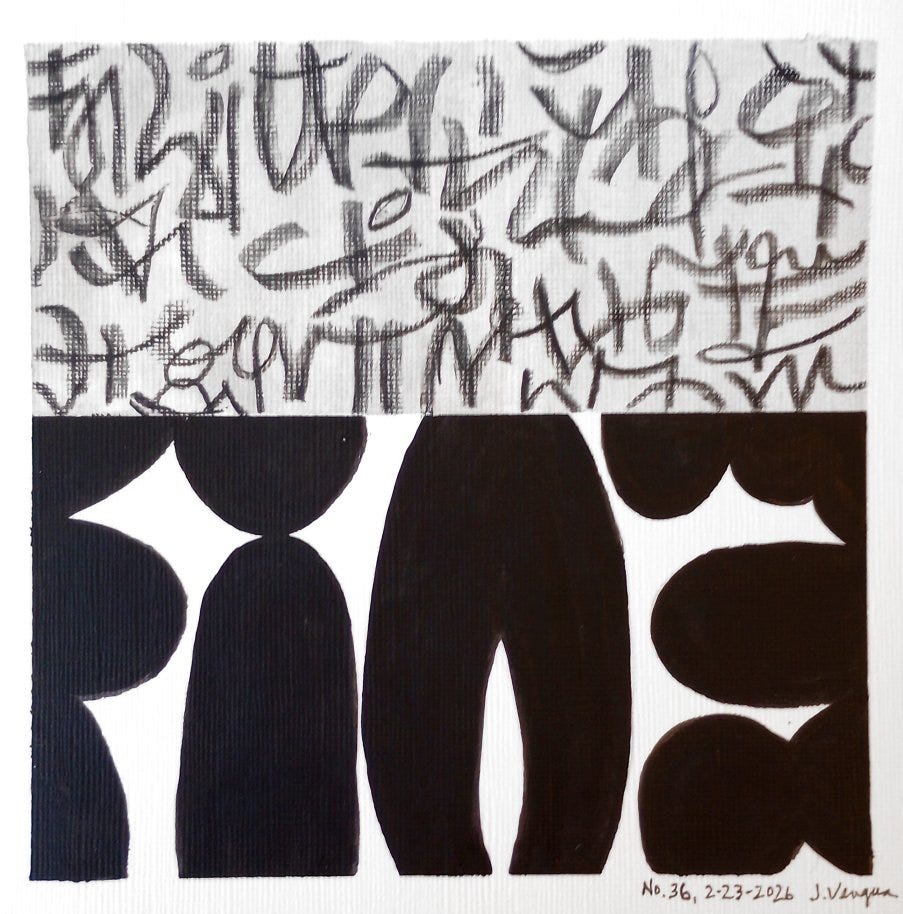
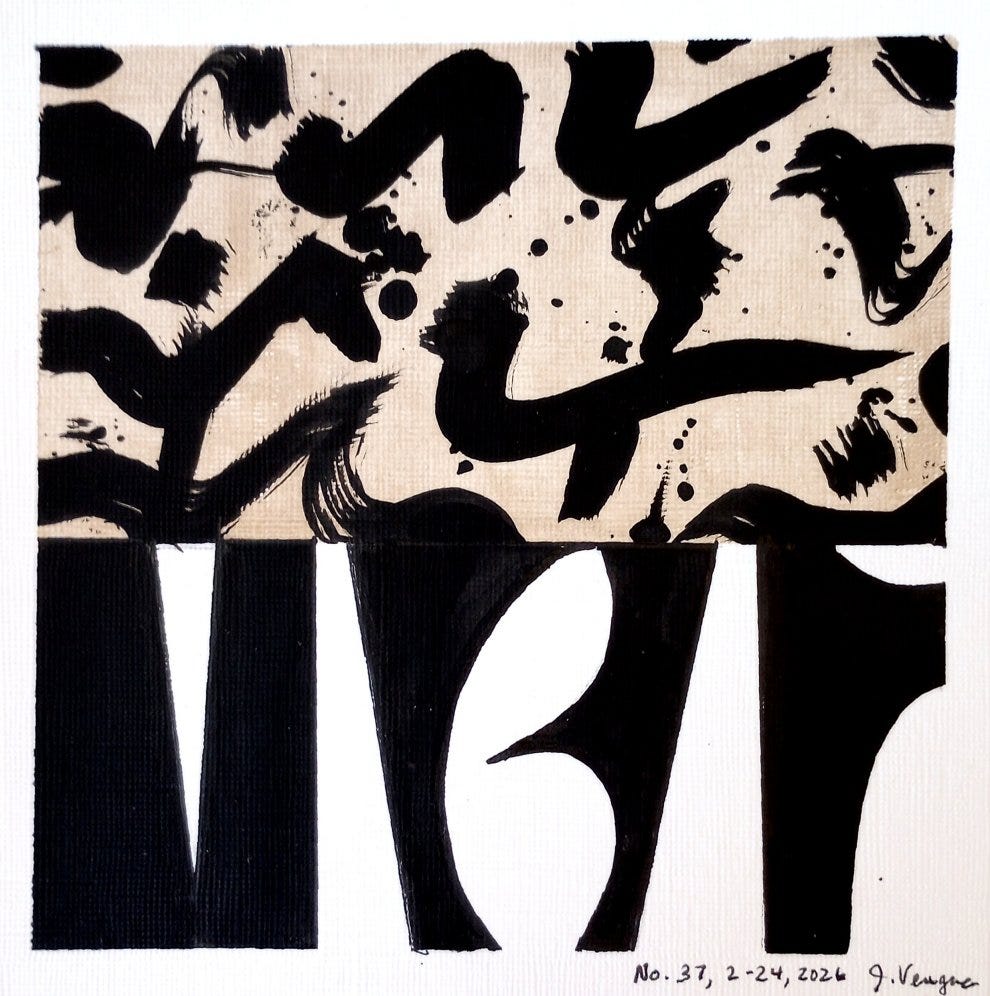
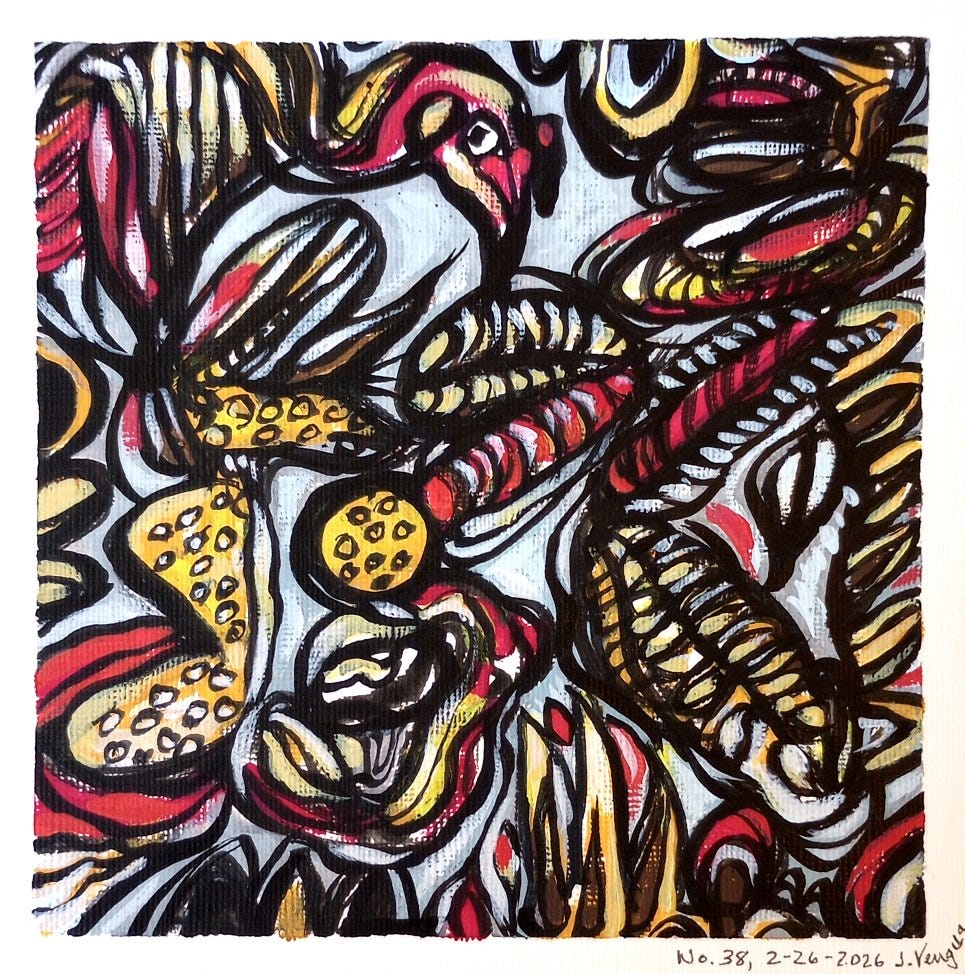
Anybody else out there have a daily art practice? Does it affect other aspects of your life? Here are several small works from my Daily Art Cycle:
THEN & NOW
Filipino Freemasonry and the Expanding Circle
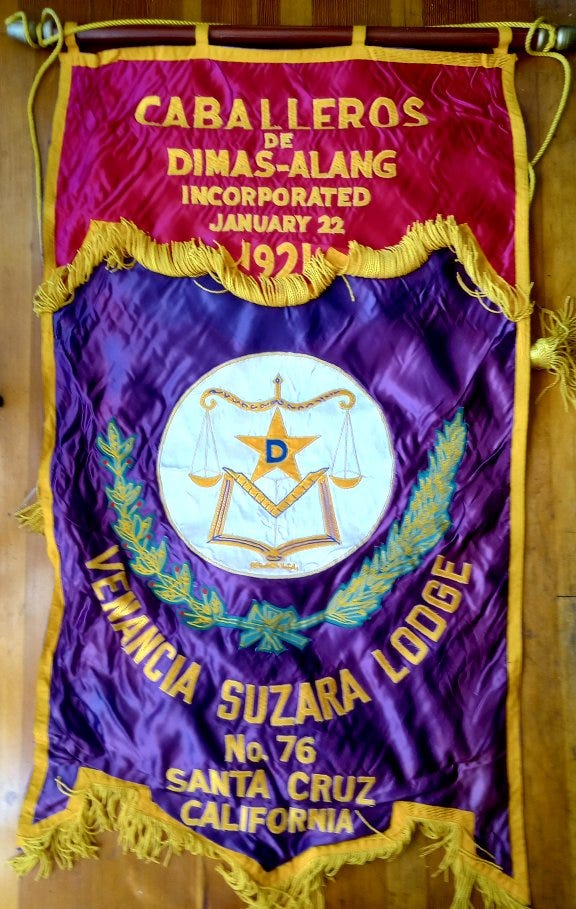
When I was still a child, my mother became involved in Filipino Freemasonry in the form of the Caballeros de Dimas-Alang. I don’t know exactly what sparked this interest, but I began to see an increase in new “aunties and uncles” visiting our house. These friends were not all acquaintances from Mom’s cannery job. Some of them were associated with small businesses or farms in Salinas Valley—but as contractors, not as farmers. They were Filipino men and women who mediated between farm laborers and the rich farmers who owned the huge vegetable farms that have been the economic drivers of the Pajaro and Salinas Valleys and much of Central California for over a century. If you’ve read John Steinbeck’s The Grapes of Wrath and In Dubious Battle, or Carlos Bulosan’s America is in the Heart, you know what I mean.
Filipino American contractors in the 1930s-60s often (though not always) started out as immigrant farm laborers who rose in the ranks to take on important responsibilities on the farms, and eventually found ways to profit from their connections to both laborers and farmers.
Mom knew nothing about the history of Filipino farm workers in the US, and had her first exposure to the lousy conditions in some of the labor camps1 in the 1960s when accompanying her friends on visits. There she met the manongs—older male workers who had been contracted to migrate to the US to work on the farms during the 1920s and 1930s. My father had been among those workers, and knew some of the men who lived at the camps. One of Dad’s best friends, Mauro, was still working on one of the Pajaro Valley farms when he was in his 70s.
Mom learned from Dad and local Filipinos to treat the manongs with respect, since their hard work paved the way for immigrants who arrived in the US in the mid-20th century. But she identified more with the entrepreneurial ambitions of her new friends, having owned and managed her own beauty salon in the Philippines.
Filipino organizations in central California have functioned as ready-made communities welcoming new immigrants, helping them get settled, find friends, and employment. Often they were organized around geographic locations and ethnic and cultural affiliations in the Philippines. Mom joined the Filipino Community organization of Watsonville, a nearby town. She also had friends who were members of the Legionarios de Trabajo, which was closely aligned with farm laborers and their families. But the brotherhood and sisterhood of Caballeros de Dimas-Alang (CDA) had an attraction that was part historical, part communal, and part mystical.
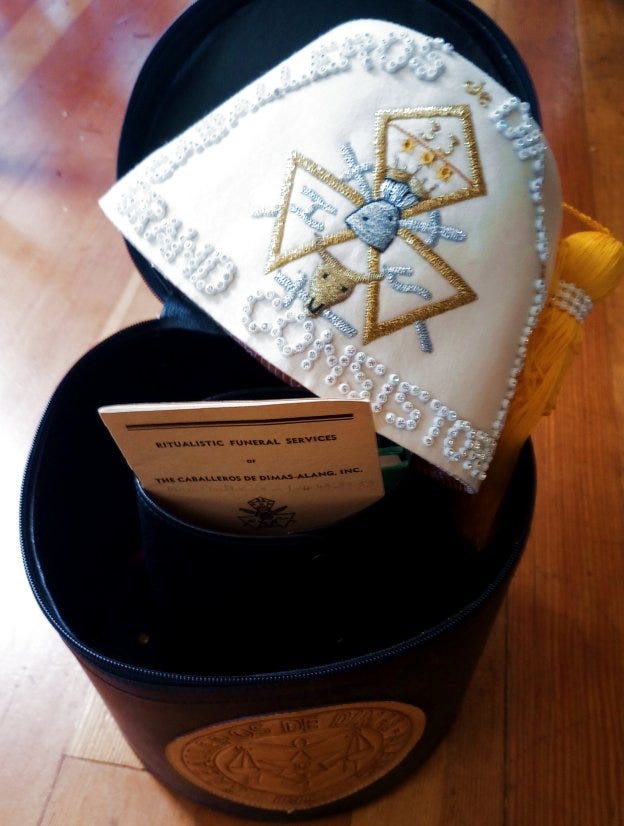
To me, the CDA seemed esoteric, secretive, and a bit odd. During formal, public events, members wore gold-tasseled caps, fringed and embroidered satin aprons, and sometimes the men carried what looked like fencing foils. In specially designed hatboxes they secreted handbooks that were for members’ eyes only. As a child on the “outside,” I did not know what secret signs and rituals were involved. Did they hold initiation rites? Were they given secret names? Did they engage in magic?
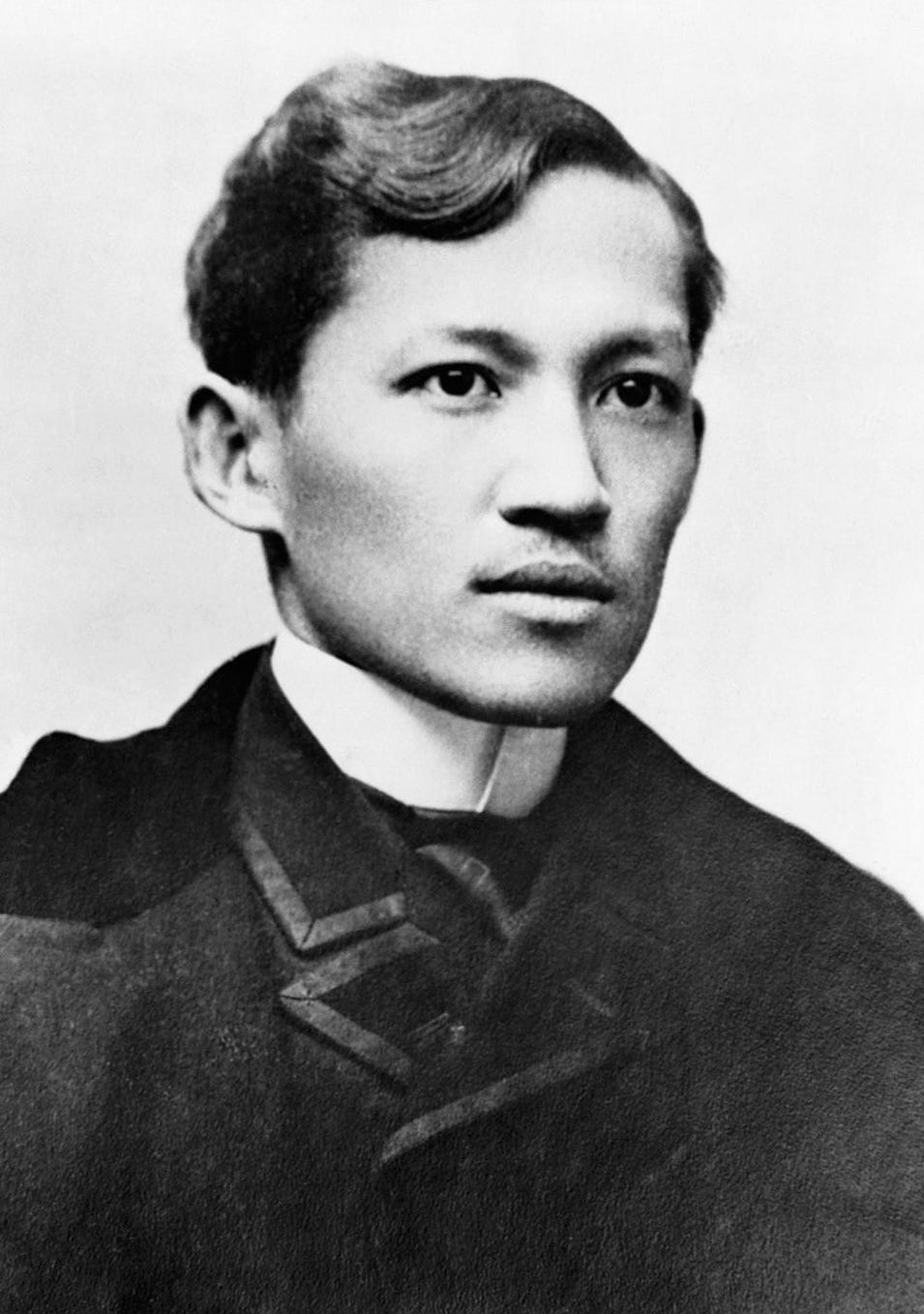
The history of the CDA is closely tied to the Philippines’ polyglot national hero, Jose Rizal, who was first exposed to Freemasonry—and became a member in Spain and achieved the rank of Master Mason—while attending college in Europe. And though Rizal was not technically “revolutionary,”2 his novels Noli me Tangere (aka The Social Cancer) and El Filibusterismo (aka The Reign of Greed) earned him the wrath of the Catholic friars and the Spanish colonial government in the Philippines. After he was imprisoned and executed by the Spanish authorities, his pen name “Dimas-Alang“ (untouchable) was taken up by Filipinos during their revolution against Spain. Many of the leaders of the Filipino revolt were themselves Freemasons.
In his article “A Second Home,”3 scholar and journalist James Sobredo observes that “Many of the leading figures of the Filipino fight for independence were Freemasons. Masonic lodges provided much of the infrastructure and networking that helped power the anti-colonial movement. As a result, Masonry has been strongly identified with Filipino nationalism for more than a century, both on the islands and, increasingly, within immigrant enclaves.” He noted that Rizal viewed Masonry as a “universal protest against the ambition of tyrants” and the “supreme manifestation of democracy.”4
Affiliating oneself with the CDA is a way to strengthen ties with community, provide mutual aid,5 and support business goals. But beyond that, it also provides a communal link to the Philippines’ nationalist revolt against Spain and a sense of unity forged through ritual and identity, albeit framed by liberal and progressive “Continental“ ideals.
Because of Mom’s membership in a women’s lodge of the CDA, our circle of friends and acquaintances rapidly expanded beyond our little neighborhood on the west side of Santa Cruz, where my school and Mom’s work at the cannery were located. I think these organizations helped to mitigate Mom’s loneliness, grief, and regret after her mother died. She’d had to deal with that mostly alone, with my Dad far away working at sea.
Soon, Mom had a network of friends and visitors from urban areas like Los Angeles, Sacramento, San Francisco, and even Seattle. Even better, we had a new car and could visit these places.
As a result, my life changed dramatically. It became more exciting—and more stressful.
—Read Part II of this narrative next week.
RABBIT HOLE
The Strother School of Radical Attention studies and discusses systems of attention exploitation, which they call “attention fracking.” Their Substack newsletter is The Empty Cup.
Pittsburgh artist Seung Ah Paik creates body landscapes, using her own body as model. Content warning: nudity
Fil-Am artist Char Villena on leaving Instagram
The Power of Personal Narrative and the tensions therein, by J. Christian Jensen:
Since I started my daily art cycle (and every piece is 6x6" inches or smaller), I’ve also been thinking about the genre of micro-memoir: Beth Ann Fennelly’s 2-part guide to writing micro-memoir
Lindsey Frances Jones on “Art is What Happens When Things Fall Apart,” from her Substack Art School of Life.
Devon Rodriguez makes portraits of passengers in the South Bronx underground subway, and often gifts the drawings to his subjects.
SOUNDINGS
Toro y Moi has been around for about 15 years, but I only recently stumbled on several videos from their release Mahal, where I noticed a Philippine jeepney figured prominently. They will be playing Carnegie Hall on March 3rd! Lead singer, producer, and visual artist Chaz Bear sounds like the guy next door, your talented nephew, or some dude you chat with while waiting for the bus. The songs are about everyday life: humble, quirky, and sometimes a bit melancholy.
Help me out, I’m in Hollywood
No self-service in the neighborhood
I know you can’t right now, but I wish you could
Pick me up, it’s got me hella shook
All the stars above, I think I see a way
All the constellations still look the same
Poor navigation, who am I to blame
No one even calls me by my real name . . .
Here’s a performance of several songs from their latest recording Whole Earth, at KEXP in Oakland, with an interview at the end:
Big thanks to all of you who read Eulipion Outpost regularly, and to those who have subscribed or donated on my Ko-fi page to support my efforts. Donations contribute to my rent payments!
My thanks and appreciation go to the Mysterious M. for editing support and expertise.
My website and blog: Jeanvengua.com
Eulipion Outpost is a reader-supported publication. To receive new posts and support my work, consider becoming a free or paid subscriber:
Notes:
When I got a bit older, my parents often brought me with them when they visited the labor camps. In my opinion, the worst living conditions were in the camps north of Santa Cruz along Hwy. 1. As a teen, I saw buildings that seemed in constant disrepair with no doors on the bathrooms, leaky pipes, and stained walls. Even when driving by them years later in the 1990s, the lodgings looked exactly the same—at least from the outside.
Not all of the labor camps were in bad condition. For example, author and lawyer Carey McWilliams noted that the Green-Gold labor camp in Spreckels during the 1930s was a “model” camp where families could live in clean, well-tended surroundings. Unfortunately, it was set on fire and destroyed by vigilantes in 1934 during the Salinas lettuce strike.
There are varying opinions, but Rizal seemed to view himself as more of a reformist than a “revolutionary.” He thought reform should be made peacefully from within the colonial system.
In “Behind the Growing Popularity of Fil-Am Freemasonry” Sobredo details the history of the CDA’s presence in the Philippines, beginning with the brief occupation of Manila by the British in 1762 where a military lodge was established, followed in 1892 with establishment of the Nilad Lodge by Jose Rizal in Manila. According to an archival note in Calisphere (UC), a branch of the CDA was formed in the US (San Francisco) in 1920.
When novelist Carlos Bulosan was hospitalized from tuberculosis in a Los Angeles sanatorium, the local CDA lodge helped to raise funds to cover his medical costs. (University of Washington digital collections).
Somehow while reading this, Jean, I remembered the work of Steffi San Buenaventura esp her writings about the Moncadistas. Thanks for jogging my memory! :-)