
Under Pressure
No. 207: Under Pressure; Translation Needed; Joe Livernois, Anthropic Settlement, Kazu Haga, Lynda Barry, Sam Wallman, Queen w/David Bowie, & Steffi Barthel

THEN & NOW
Under Pressure
As I mentioned in “Sorrows and Mourning,” 1959 had been a difficult year for my mother and her family in the Philippines with three deaths in the family including my grandmother.
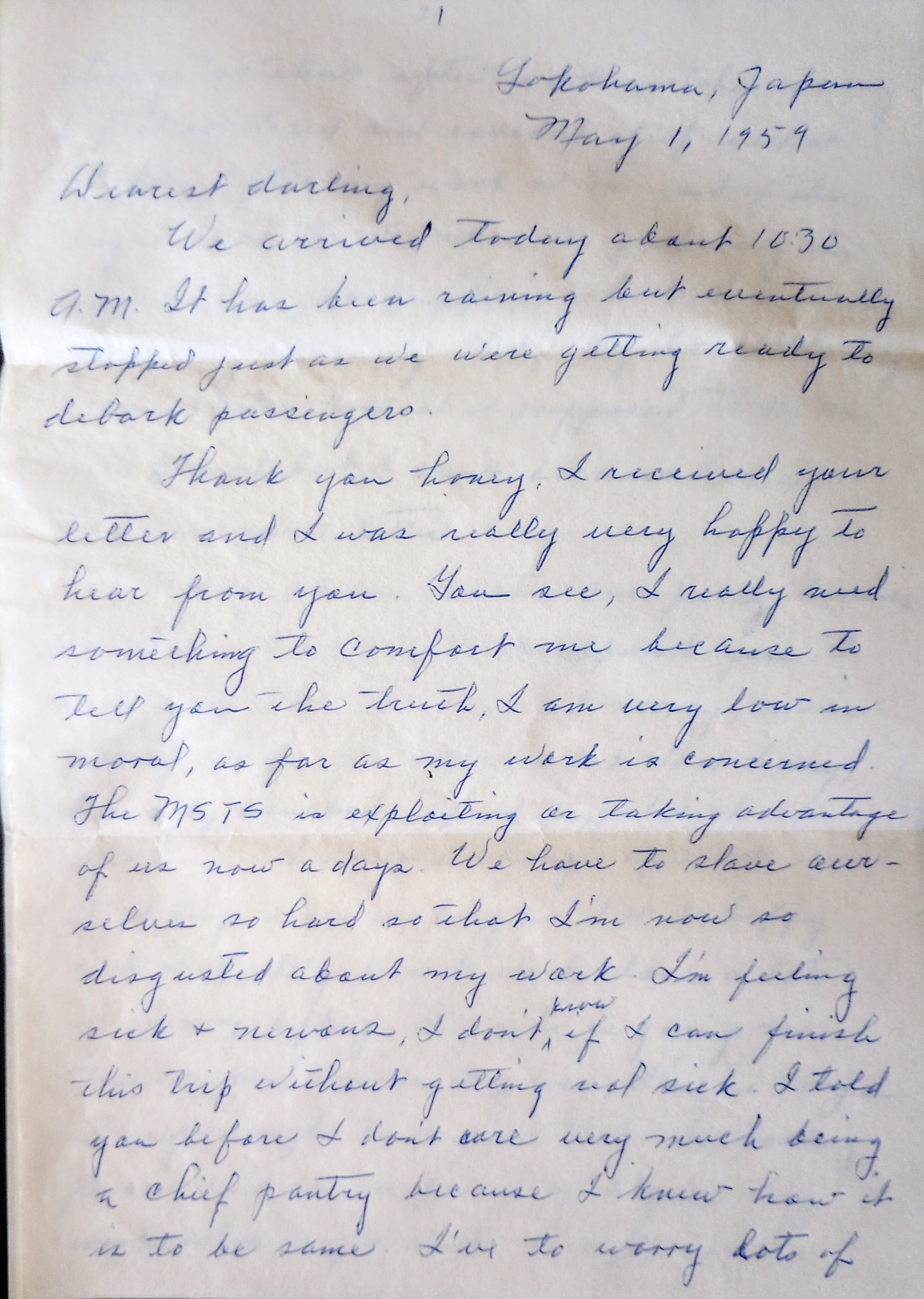
The year also held work challenges for my father, as revealed in his letter of May 1, 1959, ironically International Labour Day.1 He was then employed as a chief pantryman on the USNS David C. Shanks, one of the ships that took him to the Marianas Islands during the hydrogen bomb testing of the 1950s.
He noted that receiving a letter from my mother had been a great comfort, since he was in low spirits. But he also had some troubling news:
I am very low in [morale], as far as my work is concerned. The MSTS2 is exploiting us or taking advantage of us nowadays. We have to slave ourselves so hard that I’m now disgusted about my work. I’m feeling sick and nervous, I don’t know if I can finish this trip without getting real sick . . .
Honey, please listen carefully because I’m afraid I’m going to disappoint you . . . I know very well that we need money, more money ‘cause we [owe] a lot. But honey, I really couldn’t afford to get sick at this time. I want a change of work even if it pays less as long as I’ll be happy and well. My present work does lots of heavy lifting. My side is giving me trouble, and besides, I’m no longer strong enough to do just that [he had previously broken his ribs when falling from the ship into a lifeboat].
So darling, please don’t be surprised if I quit my work when I get back. I might even risk to leave the MSTS entirely. I only hope I’ll still have courage to stand it so that I’ll be able to come home and talk things over with you. Please pray for me darling, that my courage and strength may hold on for months yet.
He went on to report that he was experiencing “frayed nerves” and difficulty sleeping because of being “on edge” all the time. “If I don’t get out from this rotten hole I’m in, I imagine, I won’t be worth a thing, real soon.”
I recall previous letters in which Dad complained about lack of rest, limited and overworked staff to serve hundreds of passengers, paychecks arriving late, and unpredictable schedules that sometimes put his port arrivals off by weeks or even months. In the same year, he had mentioned having major disagreements with someone in management who was overseeing his work.
Yesterday, I read in social media that 2025 is the 60th anniversary of the Delano grape workers’ strike, initially started by Filipino farm workers. They were later joined by Mexican workers led by Cesar Chavez and Dolores Huerta. Their struggle prompted me to write the post above about my father’s letter.
The Delano action wasn’t the first strike that Filipinos participated in. Their labor organizing goes back to 1906 as contract sugar plantation workers, called Sakadas, in Hawai’i where they received the lowest wages among other migrant contractors. They joined with Japanese workers to strike for higher wages and better treatment.3
In the 1920s-30s, many of the Sakadas joined other Filipino workers migrating to the western states and Alaska. While they hoped for better working conditions there, they once again found themselves receiving the lowest wages among other minority groups, while also enduring racist violence, especially in California.
Unable to join the larger labor unions (until the mid-1930s), Filipinos began to form unions of their own, organizing in California, Washington state, Alaska, and Oregon, and supporting or collaborating with other unions (for example during the west coast dockworkers’ general strike of 1934). The 1934 and 1936 lettuce worker strikes were initiated by Filipinos in the Salinas Valley (where they founded a local chapter of the F.L.U. (Filipino Labor Union), and they organized the successful 1938 asparagus cutter strike in Stockton.
My father was an agricultural and cannery worker in all the western states during the most volatile period for Filipino labor in the US. He also canned fish in Alaska, and probably picked every row crop grown in the west. Eventually he left life as a farm worker in order to toil in San Francisco’s restaurant kitchens.
During World War II, I think he hoped that his tenure in ships’ galleys (even in positions of higher seniority, such as chief pantryman and steward) would improve his working conditions and raise his pay; it probably did. But as his letters revealed, life as a seafaring Filipino working on merchant marine and military vessels was still a struggle.
NOW
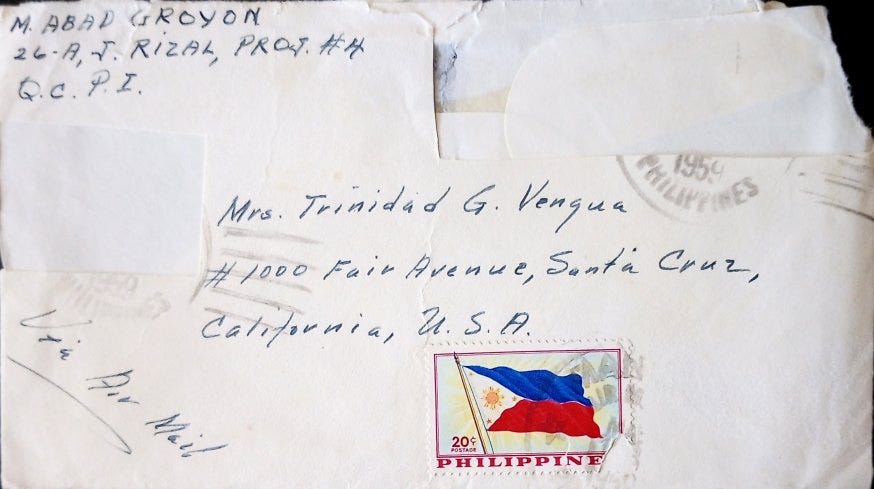
I found a May 1959 letter from my grandmother, Matea. Unusually, it was addressed to my mother and father, and myself. Normally her letters were addressed only to my mother. The return address on the letter itself suggests that she was writing from a hospital. It must’ve been the last letter she sent to us before she passed away. Partly because of my lousy ability to read Tagalog, and partly because my lola’s (grandmother’s) handwriting in pencil is difficult to read, I have not been able to translate it.
So, I’ll be searching for someone to help me translate it. And (depending on the content), I may write about this letter in the future.
RABBIT HOLE
“The Volatile Crops of Salinas,” Chapter 1 and Chapter 2, by Joe Livernois in MN&F (Monterey Neighbors & Friends)
What authors need to know about the $1.5 billion Anthropic settlement. Cogent Echo provides a pretty good summary:
Buddhist teacher and activist Kazu Haga on injustice as a manifestation of collective trauma. Includes a meditation practice session:
Cartoonist Lynda Barry on how to silence your inner critic:
Sam Wallman is an illustrator and “comics-journalist” based in Naarm / Melbourne, living in unceded Wurunderji country. He co-founded the Workers Art Collective art studio at Victorian Trades Hall in 2014, where he continues to work. He works part-time as a wharfie / longshoreman.
SOUNDINGS
“Under Pressure” performed by Queen, sung by Freddie Mercury and David Bowie (from the Queen Official channel):
Part of the musical duo4 Cascade, Steffi Barthel plays Jimi Hendrix’s masterpiece “Little Wing” on a Chapman stick — wait for her reaction at the end of the piece! (A Chapman stick is one of those instruments I would love to have and learn to play):
Big thanks to all of you who read Eulipion Outpost regularly, and to those who have subscribed or donated on my Ko-fi page to support my efforts.
My ongoing appreciation goes to the Mysterious M. for his editing.
My website: Jeanvengua.com
I just started a new blog, Eulipion Post, as a way to document postal art I receive and send.
Eulipion Outpost is a reader-supported publication. To receive new posts and support my work, consider becoming a free or paid subscriber.
Notes:
Labor Day in the US is celebrated on September 1st — last week!
Military Sea Transportation Service.
Some historical context: In 1898, US forces arrived in the Philippines ostensibly to support Filipinos in their fight for independence from Spain’s rule. However, in the Treaty of Paris (1899), Spain ceded control of the Philippines to the US for $20 million. This act prompted a revolt by Filipinos against the US forces. In the resulting Philippine-American war, thousands of US and Filipino combatants were killed, as well as nearly 200,000 Filipino citizens. After the Philippines was secured, the US sent contractors to the archipelago to recruit Filipinos to labor in America’s agricultural fields. They were first employed in the sugar plantations of Hawai’i. As “nationals” they could migrate to the US for work, but could not become citizens.
Cascade is occasionally a trio.
Hi Jean! Thank you so much for sharing your story. :) I understand Tagalog, so let me know if I can be of help in translating!
Let me know if you want me to look at the letter. I understand Tagalog.