
Learning to Fall
No. 228: Daily Art Cycle; Learning to Fall; Michio Ito, Charles Yang x 2, NYC Ballet, Martin Edmond, Ann Weber, Budget Filmmaking, & "Little Fugue" (Azusa Pacific U. Orchestra)

ART
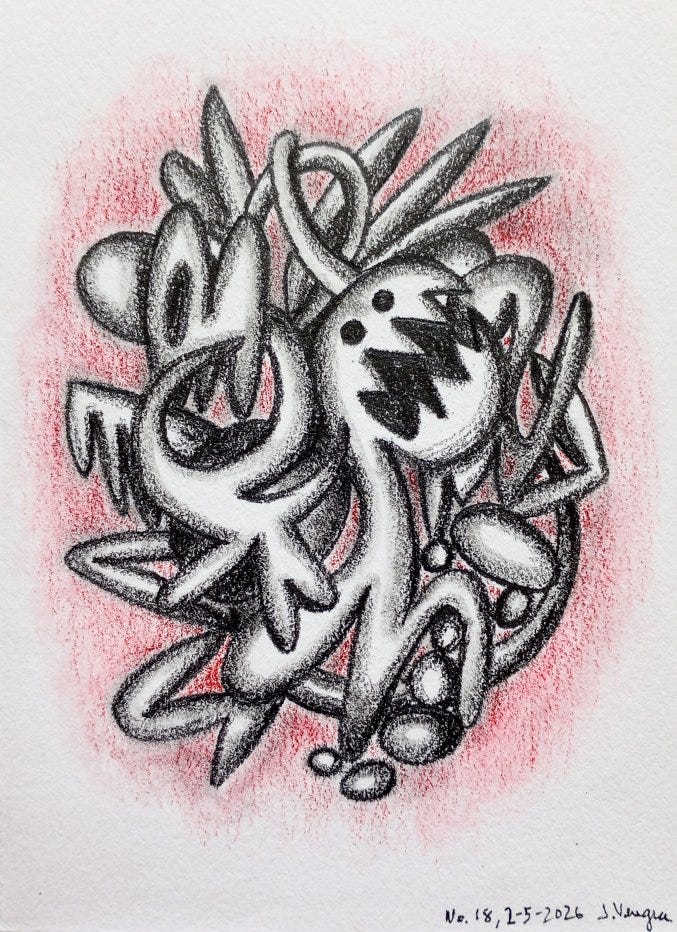
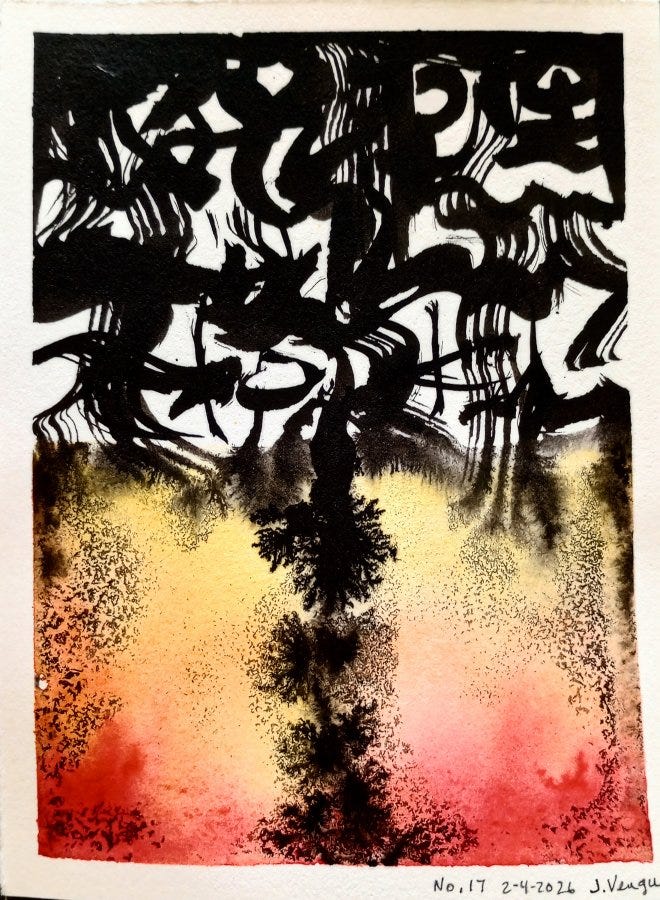
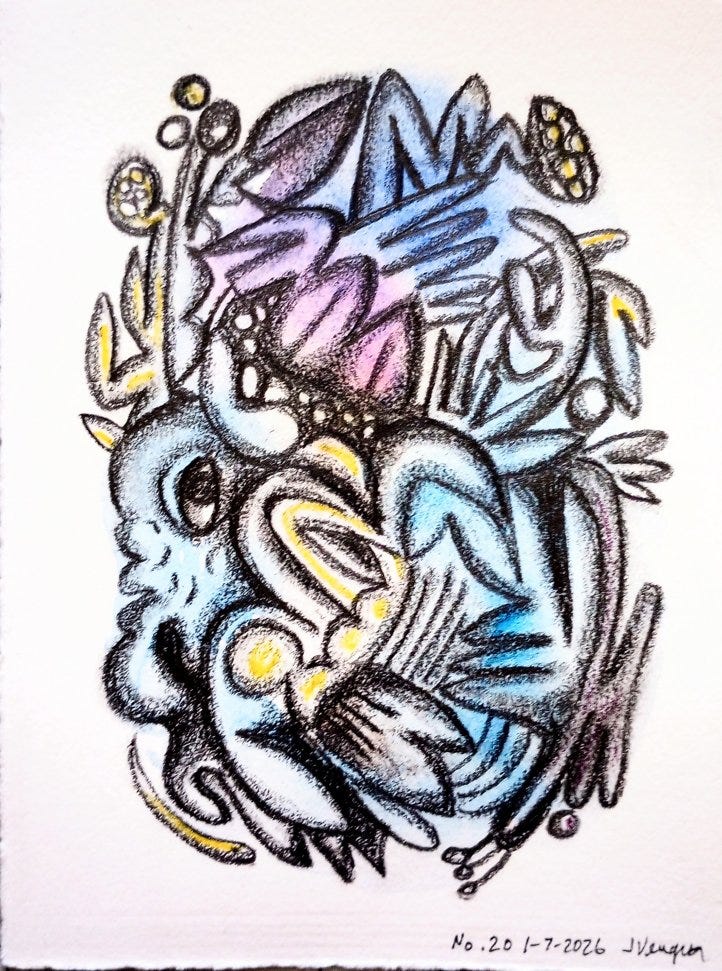
Daily Art Cycle
At first I called it a “daily drawing” project; later, I called it “daily drawing and painting project.” Now I’m calling it my “daily art cycle” since it could be drawing, painting, or multi-media, and I’m doing it in cycles of 100. And every time I hit 100 I will reward myself with a (very) small but fancy cake from Parker-Lusseau or Alta Bakery.
These small works (4.5 x 6 or 6 x 6 inches) are also inspiring ideas for larger ones—so that’s a plus.
Lately, I’ve been doing these little drawings in graphite that include plant-like forms entangled with animal- or monster-like creatures. Words like “entanglement,” “sentience,” and “interbeing” come to mind.
THEN & NOW
Learning to Fall
So what DID happen with that restaurant partnership I mentioned in “Sticky Rice Cake & Brown Sugar?” I’ve looked through the 1965 letters, but have found no other references to the project (so far). My guess is that my parents finally had to concede that they just didn’t have the money to go for it. So many of my father’s letters during that period suggest they were just managing to keep the bills paid.
And frankly, my mother’s ambitions for the house,1 and for our family, and her only child (me) seemed to be taking up a lot of the funds. My parents had surprised me with a piano for my fifth birthday (which I was tentatively happy about, but also dismayed when I realized that I was now expected to take piano lessons and practice daily). Mom also enrolled me in ballet classes at the Fort-Barka School of Dancing. Before purchasing the Chevy Corvair, Mom would accompany me on the bus to the school, located in an old Craftsman style house on Mission Street. I remember carrying a round, pink vinyl case decorated with images of tiny dancers that held my ballet slippers.
My dance instructors were Miss Fort and Miss Barka. Miss Fort looked like a slightly stooped Italian grandmother: her long, greying black hair bound up in a bun. Miss Barka was tall and slim, with perfect posture, and hair cropped short. I thought she looked like an aged Mary Poppins; all she needed was an umbrella and a satchel. The ballet studio’s large waiting room was equipped with a rambling “cat tree” for the many felines that lived in the studio, which was also home for the two women. A wooden staff was kept leaning against one wall, which both instructors would use to beat rhythmic time on the floorboards as the students twirled, jumped, pliéd, and performed bar exercises.
Back in those days, we had an unfortunate and even cruel term for women like Miss Fort and Miss Barka, who were unmarried in their 60s and lived together: “old maids.”
Yet, I now remember something I had forgotten: the interior walls of their Craftsman studio were reverently hung with signed, black and white or tinted photographs of modernist and experimental dancers of the 1920s-30s, innovators like Nijinsky, Isadora Duncan, Ruth St. Denis, Ted Shawn, and Martha Graham. We students imagined our elder teachers as lithe, young dancers, and wondered if they had studied or performed with some of these famous people in the photographs.
I didn’t realize it then, but Miss Fort and Miss Barka brought a rather worldly and artistic vibe to Santa Cruz. I looked for references to their dance school in old copies of the Santa Cruz Sentinel and found them mentioned in the Nov. 14, 1933 issue. They had been teaching for many years! The article reported on a student recital of “interpretive dances” that they were holding at the Sunnyside Book Shop.2
The program will also include interpretative dances by children of the Fort-Barka School of Dancing, accompanied by Miss Barka at the piano. Sheila and Brenda Doyle of Phelan Park Primary school will give a Chinese dance to represent Young Fu; Irvin Smith Jr. will do a tap dance representing the Scarecrow of Oz, and Ruth Corwin will do Gypsy and Irish folk tale dances. The hour is set at 3:30 in order that mothers who wish to bring their children may do so after school. The public has been invited.
Right next to their article on the same page was a report on the “daring originality” of renowned Japanese dancer Michio Ito at the local Veterans Memorial Hall.3 I imagine that the two dance teachers would’ve loved to attend Ito’s performance, and probably appreciated the juxtaposition of the two newspaper articles.
Eventually, I took part in the Fort-Barka student recitals, too. By then, in the mid- to late 1950s, the dancing school had many students, so the recitals were often held in junior high or high school auditoriums. There were several tiers of dancers, ranging from inexperienced newbies to what looked like nearly “professional” to me. I remember being slightly jealous of the lead dancer, who wore ballet pointe shoes on stage, and looked very grown up. She was surely on her way to a ballet career in some cultural center like New York City.
In one performance, I was a “gypsy,” complete with tambourine (I’m sure my brown complexion added to the illusion). During that rambunctious piece, I actually slipped and fell on my bum on the stage in front of a very large audience that included our family doctor and my piano teacher. But I didn’t cry or run off. By then, Miss Fort and Miss Barka had taught me how to recover from such accidents: I immediately got up and continued on as if nothing had happened. They taught me to just keep going, and I did. Another time, I was a “butterfly” prancing across the stage in tulle and yellow satin embroidered with sequins. Both costumes were sewn by my mother. I still have them, tucked away somewhere. Damn, she was an excellent seamstress!
I continued to attend classes for about seven years. I never moved very far up the ranks as a dancer, although I suspect that in those days, a young brown girl would’ve found many obstacles in her way. Still, I learned many good lessons from Miss Fort and Miss Barka, and I appreciate their kind instruction and discipline.
RABBIT HOLE
Violinist/vocalist Charles Yang chats with John Henry of Think Music about growing up and hating classical music practice as a kid, joining a garage band, learning blues and improvisation, attending Juilliard, and how that morphed into a love of both singing and violin. He also talks with some humor about his Grammy experience. See also his fantastic sound-check performance in the Soundings section, below.
This quote accompanies the film (directed by Thibaut Grevet) of NYC Ballet’s “We Exist in Time”:
I don’t have a past. I have a continuous present. The past is a part of the present, just as the future is. We exist in time.—George Balanchine
Author Martin Edmond at The Salons reads “A Day on Hiva Oa” (film).
Ever wonder if you could do something more creative with all that cardboard you are about to put in the recycle bin? I’m fascinated with this art work. Curator and artist Ann Weber presents cardboard’s infinite possibilities:
For filmmakers on a budget: Tim (Empathy Machines) has this advice “Make your own art without permission, and you will make the world a better place.” He illustrates this with the example of several excellent low-budget films in “When you have no money but still make a masterpiece”:
SOUNDINGS
Charles Yang does a “Stand By Me” sound check with Grammy-winning string trio Time for Three to an empty Tobin Center for the Performing Arts in San Antonio, TX. Yang is a concert violinist and vocalist who grew up in Austin, TX.
Azusa Pacific University Symphony Orchestra, Christopher Russell, conductor, performs Leopold Stokowski’s arrangement of Bach’s “Little Fugue.” It was recorded during the COVID-19 pandemic during the 20-21 academic year, each performer recorded their part individually for this production. Tempi pre-determined by the conductor and put into a click track with a conducting video for the musicians to follow.
Big thanks to all of you who read Eulipion Outpost regularly, and to those who have subscribed or donated on my Ko-fi page to support my efforts. Donations contribute to my rent payments!
My thanks and appreciation go to the Mysterious M. for editing support and expertise, the Bach/Stokowski video suggestion, and yummy avocado bread!
My website and blog: Jeanvengua.com
Eulipion Outpost is a reader-supported publication. To receive new posts and support my work, consider becoming a free or paid subscriber:
Notes:
Which included a future renovation and enlargement.
“Fine Program to be Given on Children’s Reading,”p. 2, Santa Cruz Sentinel, Volume 88, Number 116, 14 November 1933.
The article was found in the UCR (UC Riverside) newspaper archive, part of the Center for Bibliographical Studies and Research. “Michio Ito and Company Please in Dance Recital,“ Santa Cruz Sentinel, p. 2, Volume 88, Number 116, 14 November 1933.
Did you continue to practice piano, Jean? Love the feline cat tree at the dance studio!